


How Eli Heidenreich Earned a Roster Spot: What the Preseason Actually Showed

Eli Heidenreich was never supposed to be a lock. A seventh-round pick out of Navy, a
Mt. Lebanon native who watched draft night unfold outside Acrisure Stadium before
hearing his own name called, Heidenreich arrived in Latrobe behind a clear top two in
Jaylen Warren and Rico Dowdle and never climbed the depth chart during training
camp itself. A hamstring injury in early August cost him nearly a week of practice. By the
time the preseason opened, he needed the games themselves to make his case. He
did, and Pittsburgh kept him.

The Preseason Case, Game by Game)
Heidenreich's audition started quietly. Against Green Bay in the preseason opener, he
carried nine times for just 21 yards while playing 25 offensive snaps and three more on
special teams, a heavy workload that reflected genuine evaluation even though the per-
carry production did not pop. The Steelers; offense managed only 2.6 yards per attempt
that night, so the modest number was not entirely on him. The Jets game was even
quieter: two carries for nine yards across 16 offensive snaps and three special-teams
snaps, the smallest sample of his three appearances
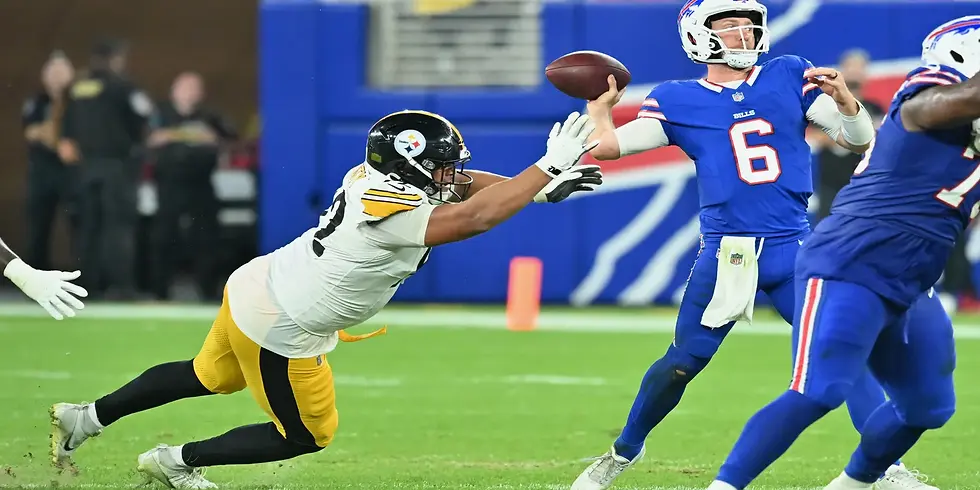
The preseason finale against Buffalo is the game that won him the roster spot. Heidenreich carried nine times for 35 yards and a touchdown, taking a pitch from Drew Allar and following a Max Iheanachor block into the end zone from nine yards out. Steelers Depots beat coverage specifically praised his vision and footwork avoiding contact in the backfield and noted that he fell forward at the end of nearly every run, a small but telling sign of leg drive and finishing strength. He added 47 yards on two kickoff returns in the same game, giving the coaching staff a second, distinct reason to value the roster spot beyond his work at running back.
The Gap in the Résumé
The most honest part of Heidenreich's preseason evaluation is what did not show up. At Navy, his calling card was receiving: 109 career catches, 1,994 yards, and 16
touchdowns, numbers that made him one of the most productive pass-catchers in
program history and the primary reason scouts tagged him a running back and receiver
hybrid rather than a pure ball carrier. He did not catch a single pass through three
preseason games.
ESPN's own preseason notes flagged the absence directly, calling it
a real complication for evaluating his NFL role given that receiving, not rushing, was
always presented as his signature trait. That gap does not erase what he did on the
ground and on returns, but it means the part of his game that made him draftable in the
first place remains almost entirely untested at this level.
Why the Roster Math Broke His Way
Heidenreich was not competing in a vacuum. Undrafted rookie Chase Nichols made his
own strong push in the same Buffalo game, rushing for 40 yards on seven carries and
adding a 13-yard catch, and veteran beat writer Mark Kaboly described Heidenreick's
roster chances as "closer than you think" heading into final cuts. The decision that
opened the door, however, came from outside the running back competition entirely.
On cutdown day, Pittsburgh traded 2025 third-round pick Kaleb Johnson to the Green Bay
Packers, clearing both a roster spot and a share of practice-squad-eligible touches at
the position. The Pittsburgh Post-Gazette's Christopher Carter reported that
Heidenreich would keep his spot on the 53-man roster alongside defensive linemen
Kevin Jobity Jr. and Gabriel Rubio, closing out one of the more notable local-kid stories
of Pittsburgh's offseason.

The Projected Role in 2026
Nothing about Heidenreich's preseason suggests he is ready to take meaningful
offensive snaps behind Warren and Dowdle, and the coaching staff has not signaled
otherwise. His actual path to the field runs through special teams. Multiple outlets
covering the roster decision framed his special-teams versatility, not his running back
traits, as the primary justification for the roster spot, pointing to a potential role as a
gunner, a return specialist, or even the personal protector on the punt unit.
The two.kickoff returns for 47 yards against Buffalo are the clearest evidence supporting a return role specifically, and his size and physicality on special-teams reps throughout camp
were cited as tangible, coachable traits independent of his touches at running back.
The receiving question remains the variable most worth watching once the regular
season starts. If Pittsburgh ever does turn to Heidenreich as a third-down or change-of-
pace option, his college production says the tools are real. Until he actually shows it in a
game that counts, his 2026 role projects as a core special-teamer with a depth-chart
running back designation attached, not the other way around.
The Verdict on Eli Heidenreich
Eli Heidenreich made Pittsburgh's 53-man roster on the strength of one strong
preseason finale, a distinct special-teams skill set, and a roster crunch that broke in his
favor when Kaleb Johnson was traded away on cutdown day. His touchdown run and
his return production against Buffalo were real, tangible evidence in a small sample. His
complete absence as a receiver, the exact trait that made him a Navy standout, is an
equally real gap that preseason football did not answer. For now, he is a running back
on the depth chart whose actual value to the 2026 Steelers will be decided on special
teams, not from the backfield.


Comments